详情
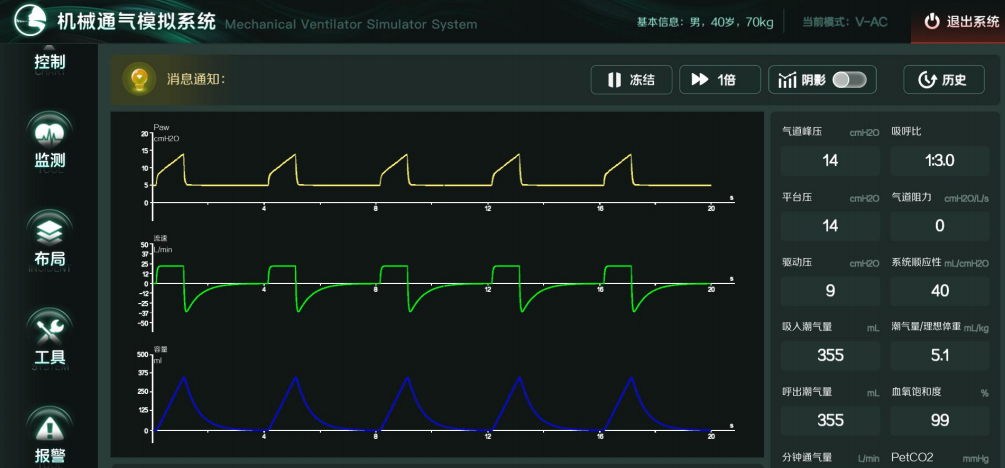
I. System Introduction A ventilator simulation and respiratory support tool based on the physiologically driven model and the mechanical ventilation driven model, which defines standard cases for normal lungs, COPD, and ARDS. It can execute corresponding ventilation modes such as controlled, assisted, and spontaneous ventilation for different cases under passive or active breathing conditions. It provides real-time changes in ventilator monitoring parameters and blood gas analysis parameters, offers routine ventilator application capabilities like parameter alarms and measurement tools. It displays real-time changes in human physiological parameters and control waveforms for real-time medical simulation. II. Technical Requirements The system's interactive interface design and development, along with art effects production, are carried out using the Unity3D game engine development software. Java and MySQL serve as the underlying services for the system, handling data interaction and building the structural framework. The system can be operated interactively using a PC. III. Functional Modules 1. Case Setup: (1) The system can set patient parameters: age, gender, actual weight, height, IBW (Ideal Body Weight). (2) The system can set the patient's lung condition (normal lung, ARDS patient, COPD patient). (3) The system can set the patient's airway resistance (cmH₂O/L/s). (4) The system can set the patient's respiratory system compliance (mL/cmH₂O). (5) The system can set the patient's spontaneous breathing frequency (1/min). (6) The system can set the patient's spontaneous inspiratory pressure (cmH₂O). (7) The system can set the patient's activity status. 2. Ventilation Mode Selection: (1) The system can select the V-AC (Volume Assist/Control) ventilation mode. (2) The系统 can select the P-AC (Pressure Assist/Control) ventilation mode. (3) The系统 can select the Spont (Pressure Support) ventilation mode. (4) The系统 can select the V-SIMV (Synchronized Intermittent Mandatory Ventilation) ventilation mode. 3. Control Parameters: (1) V-AC Mode Parameter Settings: Can set parameters such as apnea, respiratory rate, tidal volume, inspiratory time, PEEP/CPAP, flow waveform, oxygen concentration, flow trigger or pressure trigger or trigger off. The system automatically calculates I:E ratio, expiratory time, inspiratory time, and pause time based on the parameters. (2) P-AC Mode Parameter Settings: Can set parameters such as pressure rise time, respiratory rate, control pressure, inspiratory time, PEEP/CPAP, oxygen concentration, flow trigger or pressure trigger or trigger off. The system automatically calculates I:E ratio and expiratory time based on the parameters. (3) Spont Mode Parameter Settings: Can set parameters such as expiratory cycle sensitivity, pressure rise time, support pressure, respiratory rate, control pressure, PEEP/CPAP, oxygen concentration, inspiratory time, flow trigger or pressure trigger. A backup ventilation mode can be enabled. The system automatically calculates I:E ratio and expiratory time based on the parameters. (4) V-SIMV Mode Parameter Settings: Can set parameters such as inspiratory pause, respiratory rate, tidal volume, inspiratory time, expiratory cycle sensitivity, pressure rise time, PEEP/CPAP, flow waveform, oxygen concentration, support pressure, flow trigger or pressure trigger or trigger off. The system automatically calculates I:E ratio, expiratory time, inspiratory time, and pause time based on the parameters. 4. Parameter Monitoring: (1) Based on the set patient and ventilation parameters, the system performs real-time monitoring and dynamic display for the case. Comprehensive monitoring parameters include: Peak Airway Pressure, Plateau Pressure, Mean Airway Pressure, PEEP/CPAP, P0.1, Total Respiratory Rate, Inspiratory Flow, Expiratory Flow, Inspired Tidal Volume, Expired Tidal Volume, Spontaneous Respiratory Rate, Inspiratory Transpulmonary Pressure, Expiratory Transpulmonary Pressure, Esophageal Pressure, Oxygen Saturation (SpO₂), Inspiratory Time, Expiratory Time, I:E Ratio, PetCO₂, Tidal Volume/Ideal Body Weight, Airway Resistance, System Compliance, Expiratory Time Constant, Leak Volume, Oxygenation Index (PaO₂/FiO₂), Oxygen Concentration (FiO₂). (2) Based on the set patient and ventilation parameters, the system performs real-time monitoring and continuously updates the display for the case. Blood gas analysis monitoring parameters include: pH, PaCO₂, PaO₂. 5. Page Layout: Provides no less than 3 layout options for the main monitoring page waveform graphs. 6. Ventilator Interface: Displays various real-time monitored waveforms, partial monitoring parameters, preset control parameters, set case parameters, and message notifications. 7. Measurement Tools: (1) Occlusion Tool: The system provides inspiratory and expiratory occlusion capabilities. The occlusion can be manually released or automatically released based on a set time. 8. Parameter Alarms: The system allows setting upper and lower limit ranges for parameters such as Peak Airway Pressure, Minute Expired Volume, Total Respiratory Rate, Expired Tidal Volume, and Apnea Time separately. During monitoring, it prompts alarm messages when parameter values exceed the set ranges. 9. Waveforms: (1) Waveform Selection: The system provides Paw (Airway Pressure), Flow, Volume, PCO₂, Transpulmonary Pressure, and Esophageal Pressure (Pleural Pressure) waveforms. It allows setting corresponding scales and rulers for different waveform types, or can use an adaptive method. (2) Waveform Freeze: The system allows freezing the real-time waveform. After freezing, the ruler can be moved to view information at specific points on the waveform. (3) Speed Adjustment: The system allows accelerating the physiological and ventilation driving process to facilitate reaching physiological stability quickly. The maximum speed multiplier can be set to 32x. (4) Display Mode: The system allows freely switching the waveform display between line and shaded modes.